

Building Consents
A building consent is the formal approval (certificate) issued by a Building Consent Authority (BCA) that confirms we're satisfied on reasonable grounds that any proposed building works meet the requirements of the New Zealand Building Act, Building Regulations and Building Code. A building consent is required before you can begin building works (unless where the building owner has determined that the works may be exempt from requiring a consent under Schedule 1 of the Building Act).
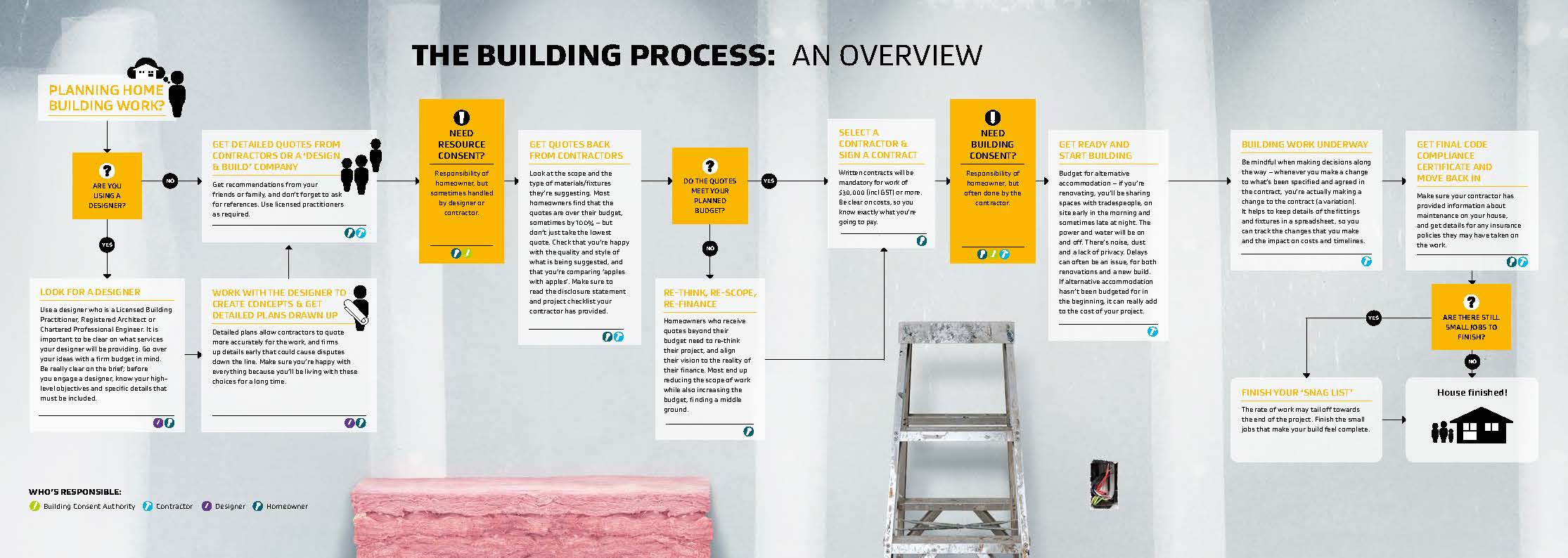
Click here to enlarge the above image (PDF, 151KB).
As an approved BCA, Grey District Council's role includes, but is not limited to, the following:
- Receiving, considering and making decisions on applications for building consents within statutory time limits;
- Undertaking inspections of building work to ensure it is compliant with the building consent;
- Issuing building consents, Code Compliance Certificates (CCC) and Compliance Schedules;
- Issuing of Notices to Fix; and
- Dealing with customer enquiries.
The roles and responsibilities of the Grey District Council as a Territorial Authority (TA) which are directly related to building control functions include, but are not limited to, the following:
- Issuing Project Information Memoranda, Building Consents subject to waivers or modifications, Certificates of Acceptance, amending Compliance Schedules and Certificates for Public Use;
- Administering audits, and enforcing Building Warrants of Fitness;
- Undertaking functions in relation to dangerous, affected, earthquake-prone and insanitary buildings; and
- Granting exemptions under Schedule 1 of the Building Act 2004. Note: It is the responsibility of the building Owner(s) to determine if any proposed building work is exempt from requiring a building consent and ensuring it complies with the Building Code.
-
Alterations to Existing Buildings
When a building is altered consideration needs to be given to how the alterations affect the existing building compliance.
-
Amendments and Minor Variations
During the construction phase of your project, it may develop that changes are necessary to the building design/construction.
-
Applying for a Building Consent
When a Building Consent is required and how to apply for one.
-
Change of Use
A change of use is where a building incorporates a household unit where one did not exist before when use of a building or part of a building changes from one use to another.
-
Customer and Designer Information
Guidance and information for customers and designers.
-
Code Compliance Certificates
Building consent inspections and Code Compliance Certificates (CCC).
-
Inspections
Inspection procedures, how to book an inspection, types of inspection
-
Licenced Building Practitioners (LBP Scheme)
-
Modular Off-site Construction and Building Products
BuiltReady is a voluntary certification scheme for offsite manufacturers, supporting innovative and efficient building methods.
-
Owner-Builder Exemption
You can build, renovate or repair your own home using the Owner-Builder Exemption, but you still need to meet Building Code requirements, apply for any consents and let your council know.
-
Processing and Granting Building Consents
Processing and granting of building consents, including consent costs and levies.
-
Producer Statements
Guidance on producer statements
-
Restricted Building Work
If you’re doing or supervising building or design work as part of the construction or alteration of residential buildings, this work may be classified as ‘restricted building work’ (RBW).
-
Self-certification for plumbing and drainlaying
From 7 September 2026, eligible plumbing and drainlaying can be certified by an endorsed plumber or drainlayer instead of being inspected by the Council
-
Solid Fuel Heaters
Guidance on Solid Fuel Heaters
-
Subdivision
-
Tiny House Guidance
Advice on Tiny House Classification and Compliance
Last reviewed: 21/10/2026


